
Destination · Nafplio & ArgolidaLeonidio.
A red-rock town under a 250-metre cliff on the eastern Parnonas — more than 2,600 sport-climbing routes, an aubergine festival, and the only place in Greece that still speaks Tsakonian.
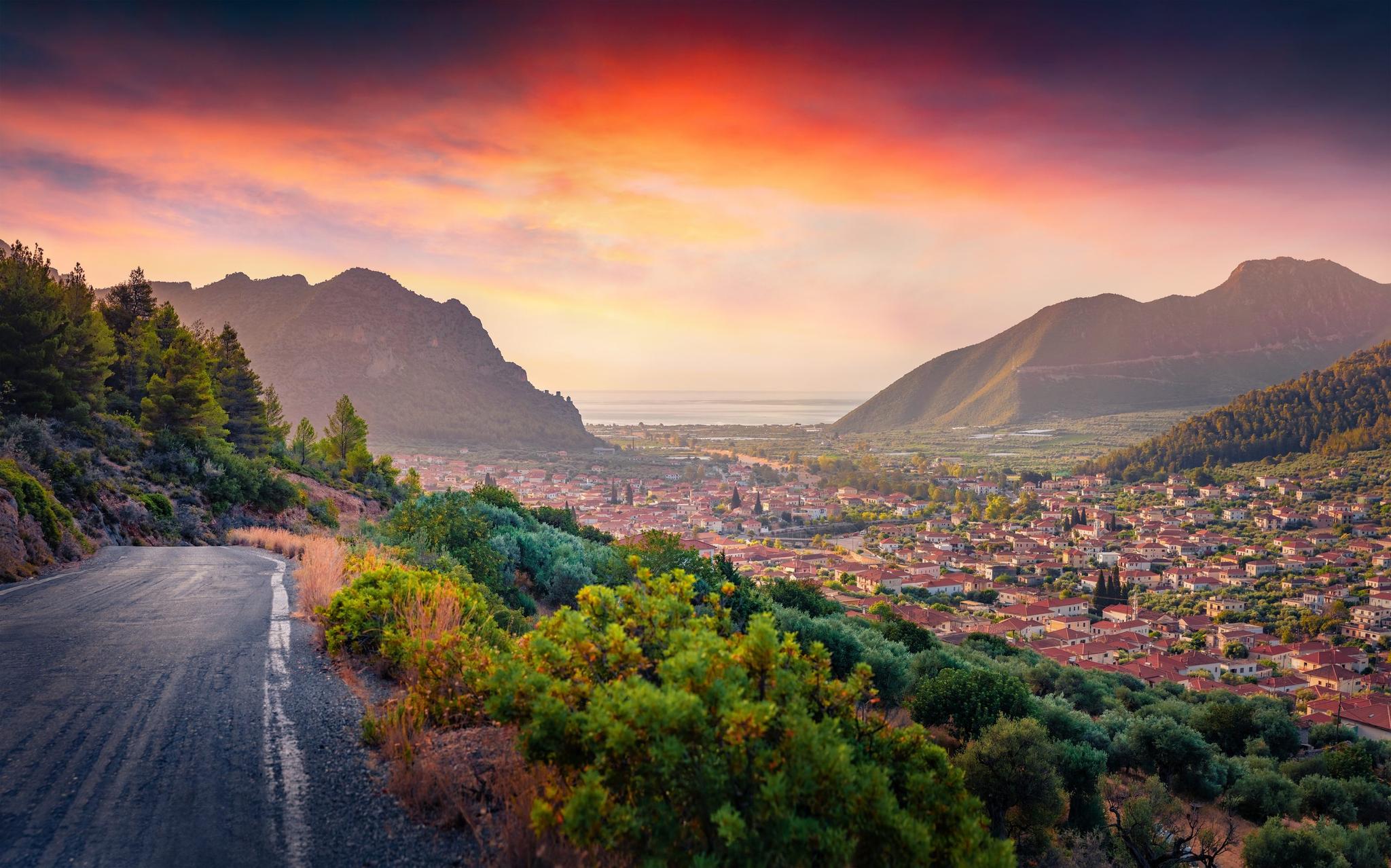
Greece's climbing capital under a red wall.
Leonidio sits in a wide green valley four kilometres inland from the eastern Argolic coast, dominated by the 250-metre red limestone cliff of Mount Parnonas rising directly behind the town.
In the last fifteen years, Leonidio has become one of the major sport-climbing destinations in Europe — over 2,600 bolted routes across 55 crags, on overhanging red and orange limestone, with grades from beginner 4a to project 9a. The climbing season is October to May; in summer the rock is too hot. The town beneath is a working agricultural centre of 4,000, surrounded by aubergine fields (the tsakoniki melitzana is the local DOP product). The Tsakonian language, a direct descendant of ancient Doric Greek and unintelligible to other Greeks, is still spoken by a dwindling, mostly elderly few — estimates run from a few hundred to a few thousand — the last linguistic remnant of pre-Slavic Greek. The seaside village is Plaka, four kilometres east — a sandy beach, a fishing harbour, and a half-dozen tavernas. Poulithra is the next bay south, quieter. The drive in from Nafplio is two hours along the dramatic Tsakonian coast — one of the great Peloponnese drives. Most visitors come either as climbers (October–May) or as travellers seeking the road less travelled (June–September). Two distinct seasons; both worth visiting.
From dawn to the late drive home.
A Leonidio day for non-climbers.
- 09:00
Coffee in Leonidio town
A Greek coffee at the central plateia in the shade of the red cliff overhead.
- 10:30
Drive to Kosmas
Forty-five minutes up the Dafnon gorge into the mountains; the road climbs through the gorge to the village at 1,150 m on the shoulder of Parnon.
- 12:00
Walk in Kosmas
Wander the stone village for an hour — the big plateia under its plane trees, the church of Agioi Anargyroi at its centre, the lanes behind.
- 13:30
Lunch at Navarchos
The old taverna on the north side of the plateia, open since 1955 — braised lamb or rabbit, a wild-greens pie, half a litre of bulk red.
- 16:00
Drive down
Slow descent back through the gorge, with the red cliff unfolding ahead.
- 17:30
Plaka beach
An afternoon swim — the water deep clear, the cliff above pink in the late sun.
- 20:00
Dinner in Plaka
Taverna tou Psara — the fisherman's taverna in a stone house on the pebble beach since 1902; half a kilo of the owner's catch, the boats coming in.
The shape of the place.
Within an hour and a half.
- 01
Plaka
Five minutes east — the seaside village with the beach. Fish tavernas, fishing harbour, a few small hotels.
- 02
Poulithra
Ten minutes south — a quieter beach village, smaller, slower. The alternative if Plaka is busy.
- 03
Kosmas
Forty-five minutes inland up the Dafnon gorge — the plane-tree plateia village at 1,150 m on Parnon; the mountain half of the day above.
- 04
Kastanitsa
An hour and twenty-five minutes by road to the north-west — the Tsakonian mountain village of chestnut trees and stone houses; a full day out, not a lunch run.
- 05
Tyros
Thirty minutes north on the coast — a working fishing village, useful as a stop on the long drive in.
- 06
Astros
An hour and a quarter north — the market town of the inner Argolic coast, with its beach quarter Paralio Astros four kilometres away; the natural halfway stop on the Nafplio drive.
Let us shape your week here.
Tell us a little about the trip you want — pace, who's coming, how you'd like to spend your mornings. We'll build the days.