
Nafplio & Argolida
Greece’s first modern capital, surrounded by its oldest places. A Venetian harbour, the Lion Gate of Mycenae, an open-air theatre that still works after 2,300 years.
The plain at the head of the Argolic gulf.
Argolida is the small fertile district on the eastern side of the Peloponnese — a triangle of farmland, citrus groves and low hills wrapped around the Argolic gulf, with Nafplio at its heart and three world-monuments in the surrounding fields.
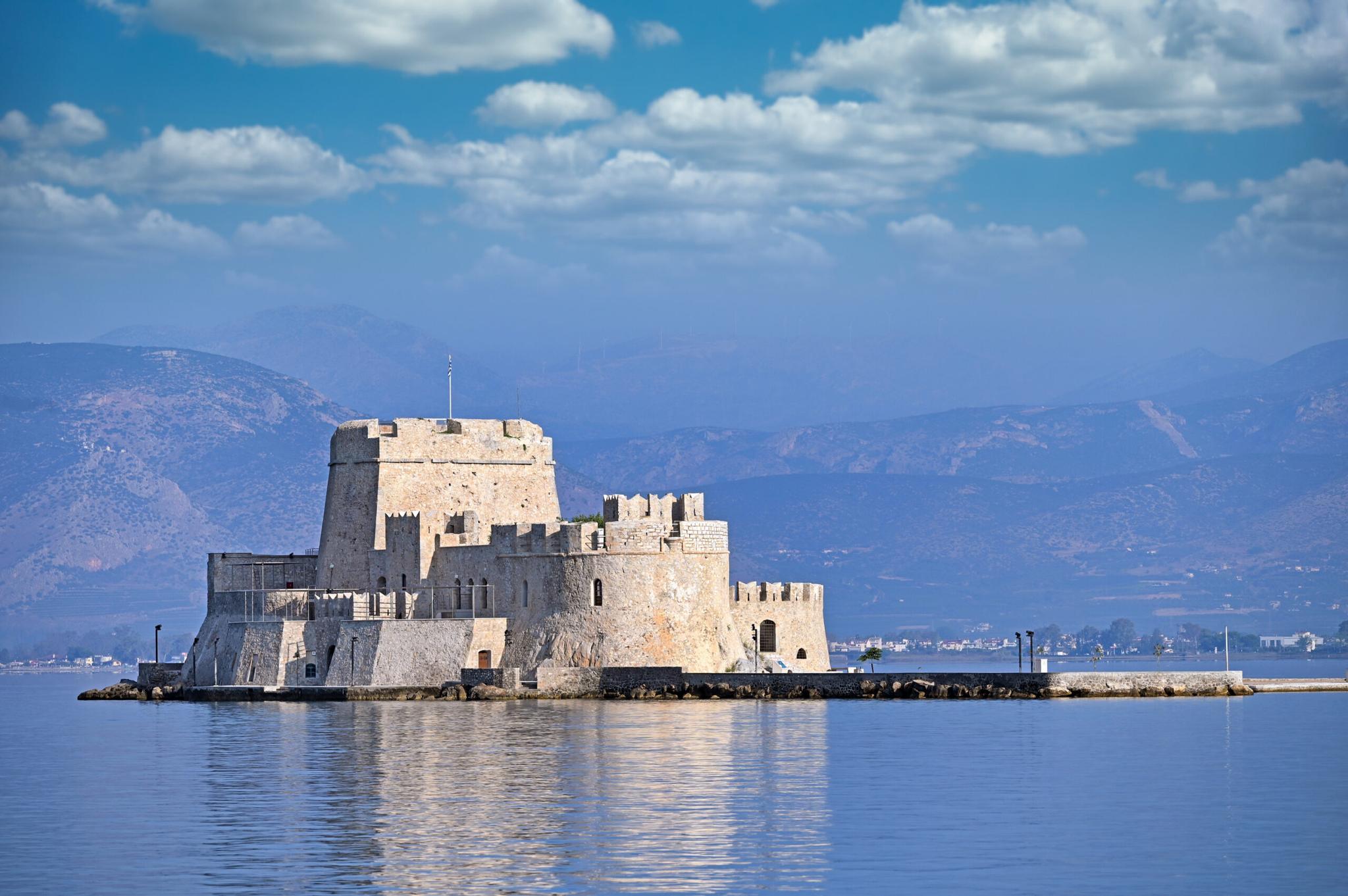
The plain has been farmed since the Neolithic — the Bronze-Age civilisation that built Mycenae and Tiryns grew its grain here. Nafplio sits on a promontory at the gulf head, with three fortresses (Palamidi, Akronafplia, Bourtzi) and a long Venetian-Ottoman main square. Thirty minutes east, the theatre of Epidaurus hosts a summer festival in the original 4th-century BC stone. Two hours south, on the Arcadian coast, is the climbing town of Leonidio; the eastern peninsula ends in the lemon-grove coast around Porto Heli.
Around the Argolic Gulf.
Hover the map or the list — they're linked. Numbered roughly the way you'd drive them.
- 01East coast
Kandia & Iria
A pair of quiet bays on the road to Epidaurus — fishing villages, vineyard tavernas, the warm shallow water of the inner Argolic gulf.
- 02Inland
Argos
One of the oldest continuously-inhabited towns in Europe — a working agricultural city with a Mycenaean acropolis above and an ancient theatre cut into the hill.
- 03Climbing
Leonidio
A red-rock town under a 250-metre cliff on the eastern Parnonas — more than 2,600 sport-climbing routes, an aubergine festival, and a Tsakonian dialect older than modern Greek.
- 04Lemon coast
Porto Heli
A deep-water bay on the eastern Argolic coast — a small town wrapped around a sailing harbour, with the lemon groves of Kranidi behind and Spetses ten minutes off.
- 05Sandy bay
Tolo
A long sandy beach in a sheltered bay just south of Nafplio — family hotels, fish tavernas, small islands you can swim out to. The summer beach for Argolida.
- 06UNESCO
Epidaurus
The healing sanctuary of Asklepios and the perfect 4th-century theatre still in use every summer. Acoustics so clean a coin dropped on stage is heard in the back row.
- 07UNESCO
Mycenae & Tiryns
The Bronze-Age citadel of Agamemnon — the Lion Gate, the shaft graves, the cyclopean walls. The wellspring of Greek myth, in open Argolida light.
- 08First capital
Nafplio
Greece’s first modern capital and the prettiest old town in the Peloponnese — marble lanes, three fortresses, a Venetian fortlet on an islet in the harbour.
One way to meet the place.
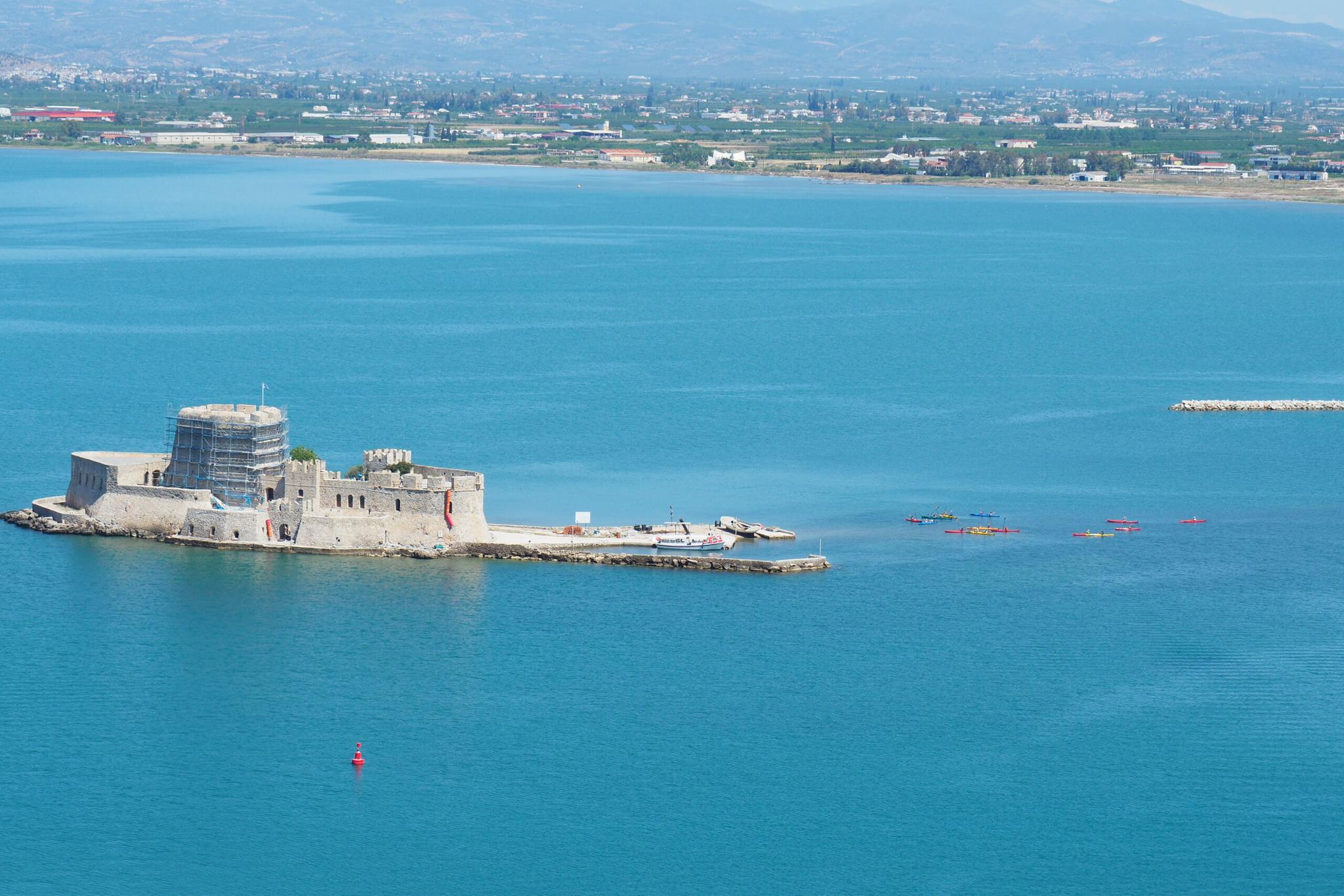
Sea kayaking the forts of Nafplio: four hours on the water, breaks included.
Trips shaped by the gulf.
Trips through Greece's first capital and the oldest places around it.
The Peloponnese Larder
Agiorgitiko in Nemea, Malvasia at Monemvasia, syglino in Areopoli and Fileri from 1948 vines.
Wine trails in the Peloponnese
2 Nemea cellars, Moschofilero 650 m up, farm cheese outdoors, Ancient Olympia early, Achaia Clauss cellars.
The Odyssey – Telemachus’ road
Linear B at Nestor's palace, Navarino Bay by kayak, Taygetos on foot, sunset at the Menelaion.
Classical Peloponnese
Epidaurus theatre, Mycenae's Lion Gate in the morning, Byzantine Mystras, Messene's walls and Olympia's 5th-century workshop of Pheidias.
The Athens extension: Nafplio and the Argolid
Corinth Canal on the drive in, Epidaurus' 55 rows, Mycenae by morning, a kayak or e-bike day.
Across the Peloponnese
Epidaurus on day one, Monemvasia's lanes at first light, a Mani sea kayak morning, Voidokilia at dusk.
Open water swimming from Nafplio
A 3.5 km swim below Akronafplia, submerged walls near Epidaurus, sulphur springs at Methana, Spetses from the water.
When to come.
Wildflowers
Mycenae and Epidaurus green and cool. Citrus blossom in the Argolic plain. Sea still cold but Nafplio quaysides full of cafe sun.
Theatre season
May closes the Leonidio climbing season; good walking in the Argolida hills. Sea reaches 22°C by mid-June. The Epidaurus festival programme begins late June.
Festival nights
Hot and busy in Nafplio old town; the Argolic coast and Tolo beach in full season. Friday and Saturday performances at Epidaurus most weeks.
Our favourite
Sea about 25°C in September, still 23°C in October. Fewer crowds at the sites; Mycenae golden in afternoon light.
Citrus & quiet
Citrus harvest in the plain. Nafplio is a winter weekend town for Athenians; the beach villages largely close, while Leonidio’s climbing season is in full swing. Mycenae empty and astonishing.
What makes Argolida, Argolida.
Nafplio, and the making of modern Greece
From 1827 to 1834 Nafplio was the capital of the newly independent Greek state. Its first governor, Ioannis Kapodistrias, landed here in January 1828 and was assassinated on the steps of Saint Spyridon in 1831 — the bullet mark is still in the wall. The old town is the architecture of that moment: Venetian houses re-roofed in tile, neoclassical mansions with painted shutters, a long marble main square that is still the social hinge of the town.
Mycenae, Tiryns, and the Bronze Age in open light
Argolida gave Mycenaean Greece its name. Mycenae is the citadel of Agamemnon — the Lion Gate, the shaft graves of Schliemann, the great tholos tomb known as the Treasury of Atreus. Tiryns, eight minutes from Nafplio, is its denser, more fortified cousin: cyclopean walls so massive Pausanias compared them to the pyramids. Both stand in open farmland, with no town overlay; the Bronze Age in the Argolic plain is mostly sky and stone.
Epidaurus, and a 2,300-year-old technology
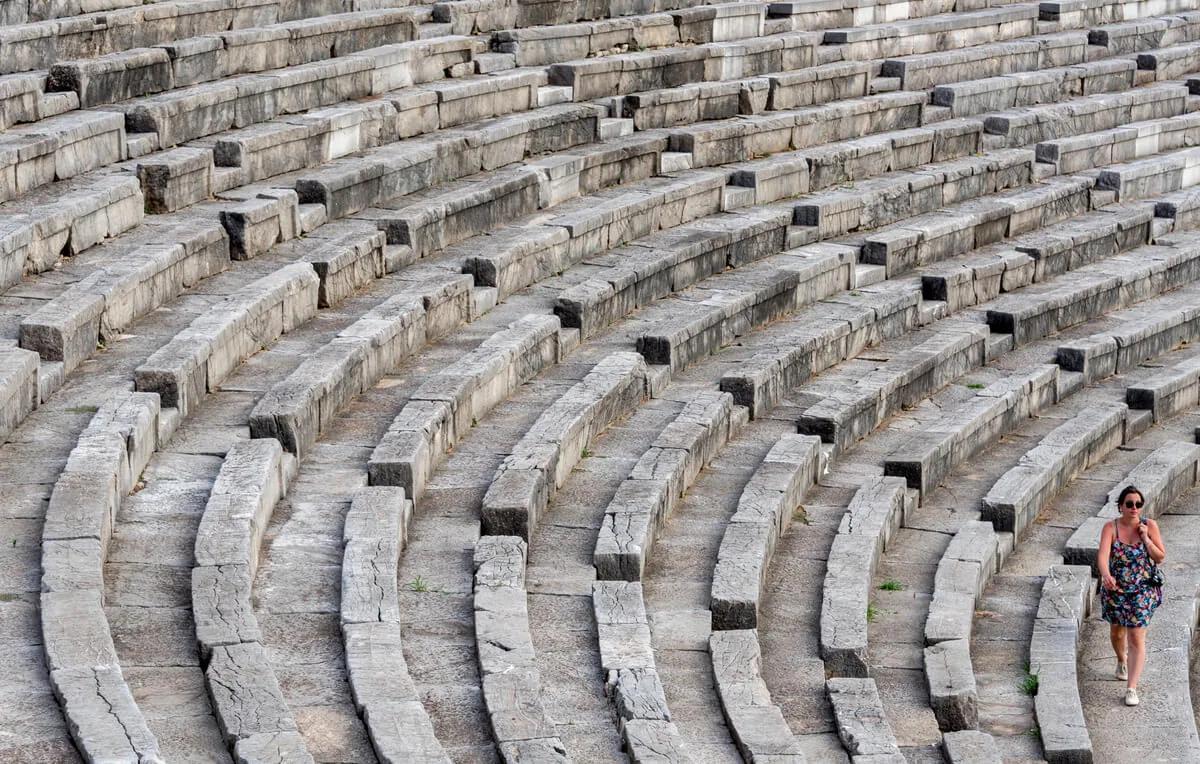
The theatre of Epidaurus, built into the slope of Mount Kynortion in the 4th century BC, holds 14,000 people in fifty-five rows of stone. Its acoustics are famous: a coin dropped on the orchestra stone is audible in the top row. Each summer, the Athens & Epidaurus Festival programmes Aeschylus, Sophocles, Euripides and Aristophanes on the ancient stage — you sit where audiences sat more than 2,300 years ago.
What grows here, and how it’s eaten.
Argolic cooking is the cooking of a fertile plain and a sheltered gulf: orange, olive, artichoke, fish from the inner bay. Nafplio is the place for a long dinner; the surrounding countryside is humbler and just as good.
Artichoke festival
The main crop of the Iria valley, in fields that run from Kandia to Iria. Every May, Iria holds an artichoke festival, with dishes cooked by the locals.
The orange plain
Oranges and olives are the Argolic plain’s main crops. The harvest opens with navels in November; juice on every cafe table. The blossom in spring is unforgettable.
Gulf seafood
Shrimp cooked in a small pan with tomato, ouzo and feta. A staple of the seafront tavernas at Tolo and around the gulf.
Nemea PDO
The Nemea valley north of Argos grows Agiorgitiko — fruity, spicy, supple, distinctly Peloponnesian. Its name means St George’s grape, and it is the only variety allowed in Nemea PDO reds. On most Nafplio wine lists.
Tsakonian melitzana
The long thin pale-purple aubergine of Leonidio, with its own PDO and an annual August festival. Stuffed, grilled, or candied as a sweet preserve.
Walnut spoon-sweet
Whole young walnuts in heavy syrup — the classic Greek spoon-sweet, served on a tiny plate with a glass of cold water and a coffee.
Four kinds of room.
Nafplio’s old town, a farm in the Argolic plain, the sailing bays around Porto Heli, or Leonidio under its red cliff.
Boutique town houses
Small hotels in restored Venetian and neoclassical houses on the marble lanes, Aetoma and Pension Marianna among them. Stone vaulted rooms, terrace breakfasts, everything within walking distance.
Farms with rooms
Restored stone houses on working farms in the Argolic plain. Opora Country Living, in the Nafplio countryside, has six rooms in an orchard of orange trees and olive groves, with olive-harvest days in season.
Sailing-bay resorts
Resorts and family pensions on the eastern Argolida coast (Porto Heli, Kranidi): Amanzoe on the hill inland, AKS Hinitsa Bay on the beach facing Spetses, small pensions in town for the ten-minute Spetses ferry.
Leonidio guesthouses
Rooms in Leonidio town and at Plaka beach: Archontiko Hatzipanayioti, a listed 1809 manor in the centre, or Camping Semeli on the beach. The red cliff rises straight behind the town.
Before you go.
01Getting there
Most travellers fly into Athens (ATH) and drive on: Nafplio is 1 hr 50 min from Athens, mostly by motorway, a little longer from the airport. A natural first or last stop on a longer Peloponnese loop.
02Getting around
A car is helpful but Nafplio itself is walkable. Mycenae 30 min, Tiryns 8 min, Epidaurus 30 min. The eastern Argolic coast (Porto Heli) is 1 hr 40 min by road; Leonidio is 2 hours south.
03When to come
May–June and September–October. The summer festival at Epidaurus runs July–August. Nafplio works year-round, including winter weekends.
04What to pack
Walking shoes for Palamidi (857 steps) and the Mycenae citadel. A light jacket for theatre evenings at Epidaurus — the stone is cold after sundown. Swim shoes for the rocky east-coast coves.
05Book ahead
Nafplio old-town hotels fill early for May, September and October weekends. Epidaurus festival tickets sell on aefestival.gr once the summer programme is out; the best seats go first.
Let us shape your week here.
Tell us a little about the trip you want — pace, who's coming, how you'd like to spend your mornings. We'll build the days.