
Arcadia
The mythic interior — stone villages on the Menalon, monasteries cut into the cliffs of the Lousios gorge, plane-tree squares with woodsmoke and tsipouro. The Peloponnese at altitude.
The mountain interior the rest of the Peloponnese is shaped around.
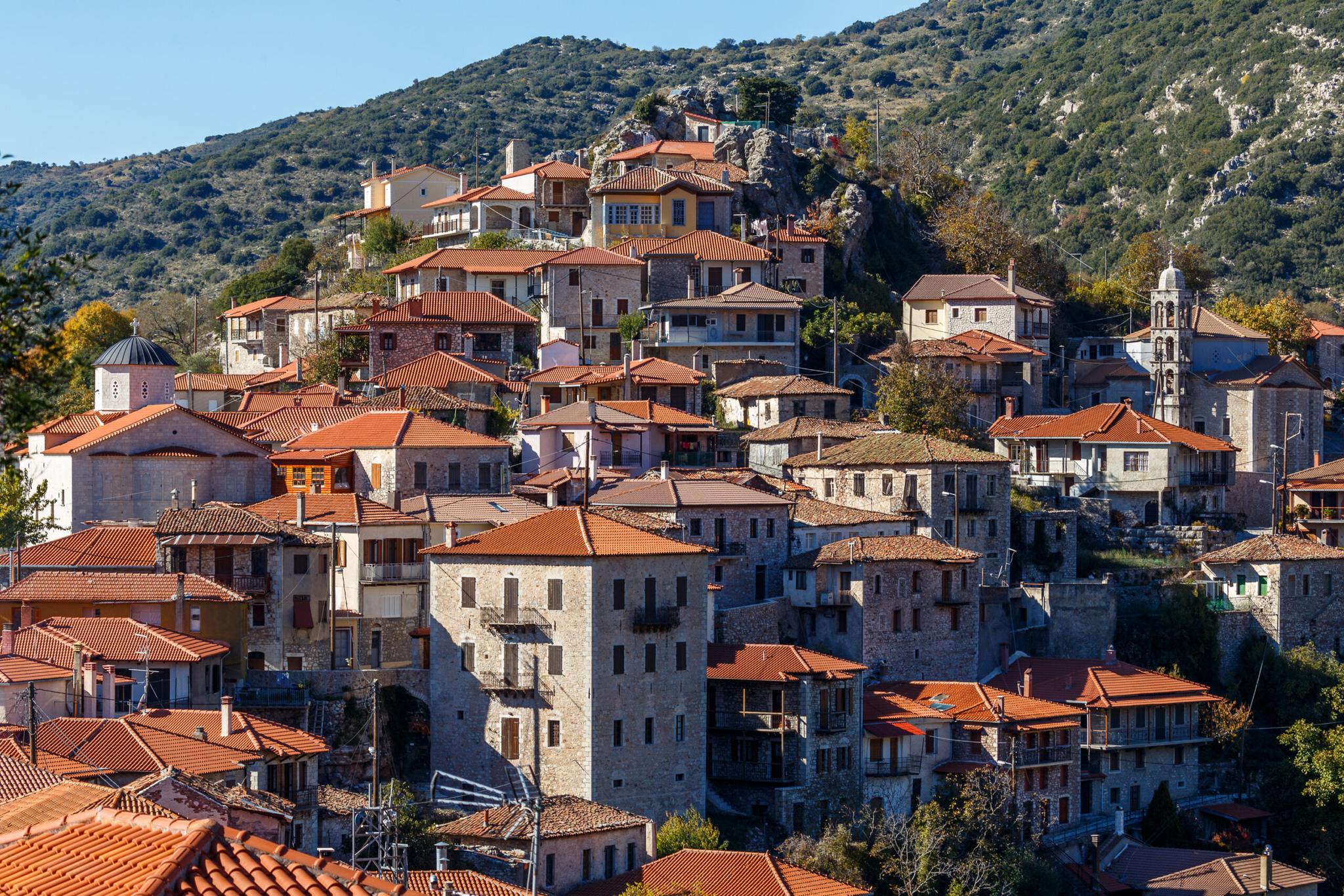
Arcadia is the mountain heart of the Peloponnese — a high inland country of plane-tree squares, stone villages on the slopes of the Menalon range, and the deep gorge of the river Lousios where four monasteries, three still working, hang off the cliffs.
The traveller’s Arcadia is the cluster of stone villages on the western Menalon — Dimitsana, Stemnitsa, Vytina, Langadia — the castle village of Karytaina above the Alfeios, and the Lousios gorge between them. The villages are built of stone, much of it laid by the master-mason guilds of Langadia (late 18th to 19th century); their squares are paved in flagstone. In winter the Menalon takes snow and the woodstoves run from October to April; in summer the squares fill with cool air at 1,000 metres while the coast bakes. This is the Peloponnese the Greeks come to in November.
Stone villages, a gorge and the high plateau.
Hover the map or the list — they're linked. Numbered roughly the way you'd drive them.
- 01Master masons
Langadia
A village built vertically into the side of a steep ravine above the Langadiano stream, a tributary of the Ladon — home of the Arcadian master-mason guilds, whose stonework is in nearly every village in the prefecture.
- 02The capital
Tripoli
The working agricultural capital of Arcadia, on a 650-metre plateau — a transit town for most travellers, but with an excellent archaeological museum and the best meat market in the Peloponnese.
- 03Wine valley
Tegea
The high agricultural valley south of Tripoli, with the ancient temple of Athena Alea and the Moschofilero vineyards of the Mantineia plateau — a white-wine country at 650 metres.
- 04Long-distance walk
Menalon Trail
A 75-kilometre certified European long trail linking nine stone villages along the spine of the Menalon range. Eight day-stages end-to-end, usually walked in four to six days, or any stage alone.
- 05Highland resort
Vytina
A higher, leafier village in a fir-forested basin on the Menalon — the weekend mountain town of Athens, with stone hotels, walnut sweets in every window, and snow most years from December to February.
- 06Frankish castle
Karytaina
A medieval village clinging to a steep ridge above the Alfeios river, crowned by a 13th-century Frankish castle — Byron’s favourite Peloponnesian view, and once on the back of the 5,000-drachma note.
- 07Canyon
Lousios gorge
A 15-kilometre limestone canyon with four cliff monasteries cut into its cliffs. The river the ancients said Zeus was bathed in. Walked end-to-end in two days on the Menalon Trail.
- 08Silversmiths
Stemnitsa
Dimitsana’s sister village, ten minutes away — a silversmithing tradition that runs back to the Ottoman period, a school of fine metalwork, and the trailhead to the Prodromou monastery.
- 09Stone village
Dimitsana
A 17th-century mountain village on a balcony above the Lousios gorge — stone houses, the open-air water-power museum, and the most considered restaurant scene in the Arcadian highlands.
Four ways to meet the place.
The Lousios gorge and four monasteries, silversmithing in Stemnitsa, hilopites and tsipouro, a day on the Menalon Trail.
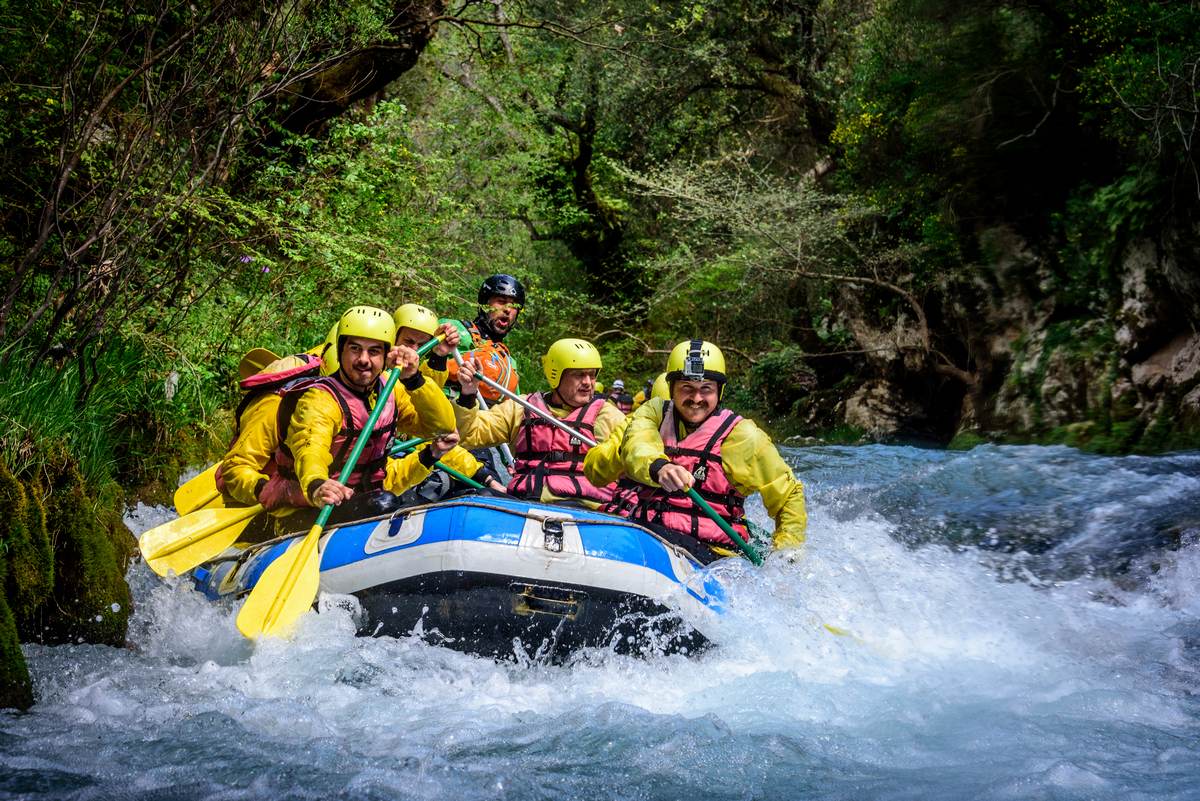
Rafting the Lousios Gorge
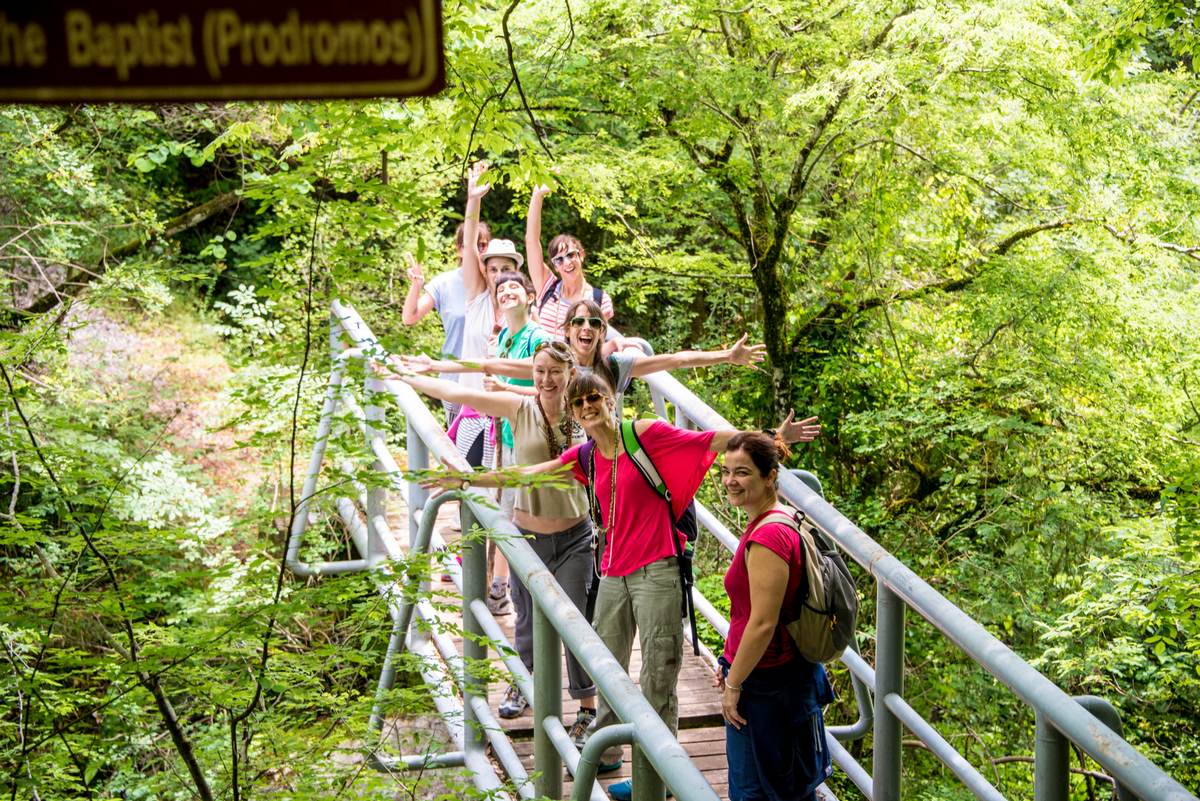
Hiking Lousios Gorge on the Menalon Trail
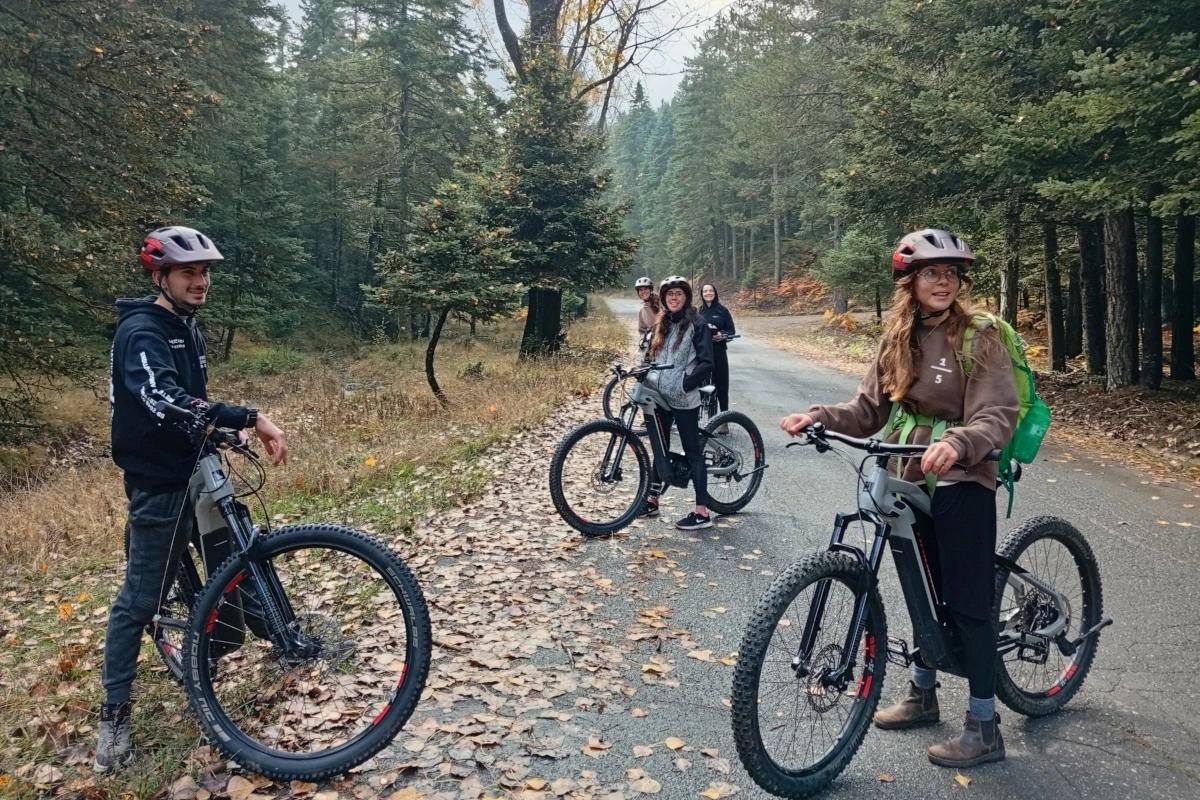
E-bike through Menalon forests
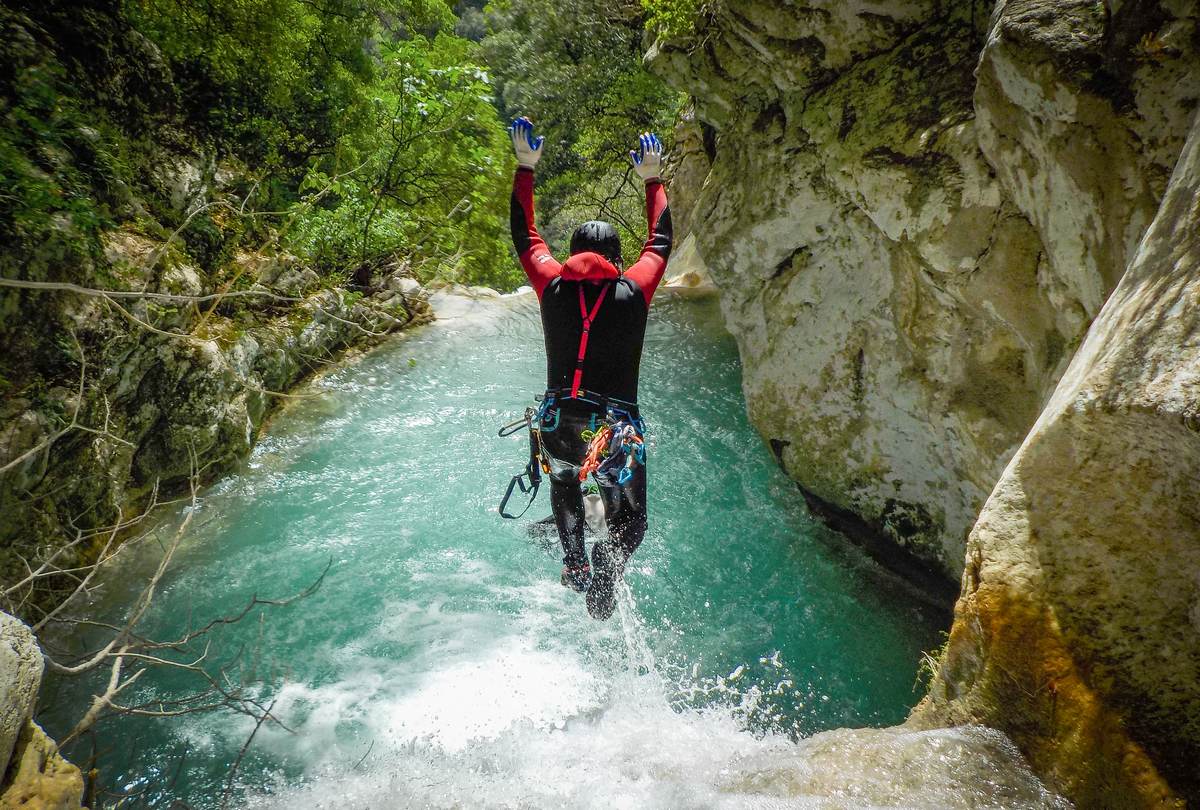
Canyoning in Neda Gorge
Trips shaped by the mountain.
Trips that draw on the stone villages, the gorge below them and the snow above.
The Peloponnese Larder
Agiorgitiko in Nemea, Malvasia at Monemvasia, syglino in Areopoli and Fileri from 1948 vines.
Wine trails in the Peloponnese
2 Nemea cellars, Moschofilero 650 m up, farm cheese outdoors, Ancient Olympia early, Achaia Clauss cellars.
Run the Menalon, recover by the sea
Nemea's athletes' tunnel, the Lousios gorge by 9am, the Pliovouni saddle, and a kayak into Kardamyli's Blue Cave.
Across the Peloponnese
Epidaurus on day one, Monemvasia's lanes at first light, a Mani sea kayak morning, Voidokilia at dusk.
E-MTB across the Peloponnese
Fir forest from 1,700 m, the Lousios Gorge rim, 1,941 m down Taygetos, sunset at Voidokilia.
Walking the Menalon Trail
Philosophou monastery from 963, the 1643 m high point, Magouliana at 1,275 m, stone-built Lagadia at trail's end.
When to come.
Snowmelt & wildflowers
Snow leaves the upper Menalon. The Lousios gorge runs at full force; the trail is muddy and dramatic. Villages quiet, woodstoves still on.
Best for walking
The high months for the Menalon Trail. Long evenings on the Dimitsana balcony, fir forests cool, kafeneia tables outside again.
Cool altitude
Coast bakes; at 1,000 metres Vytina’s July–August average high is 29–30°C. Vytina and Dimitsana fill with Athenian families. The villages have their summer festivals.
Walnut & chestnut
Planes and chestnuts turn gold among the evergreen Mainalon firs; walnut and chestnut season in the villages. The most photogenic Arcadia, our favourite month for the Lousios.
Snow on the Menalon
The Athenian winter weekend country — woodstoves, tsipouro, snow most years above 1,200m. Vytina, Dimitsana and Stemnitsa busy Friday–Sunday; midweek empty and beautiful.
What makes Arcadia, Arcadia.
Dimitsana, Stemnitsa, and the masons of the Menalon
The cluster of stone villages on the western Menalon — Dimitsana, Stemnitsa, Vytina, Langadia, and Karytaina above the Alfeios — owes much of its stonework to the master-mason guilds of Langadia, formed in the late 18th century and at their height in the mid-19th, who worked all over the Peloponnese. The houses are stone, the squares paved in flagstone. Stemnitsa has a silversmithing tradition reaching back to the Ottoman period and a school, open since 1976, still teaching it; Dimitsana supplied the 1821 Revolution with gunpowder from fourteen watermills in its gorge. These are working villages, not museums — the kafeneia have always been the centre, and still are.
The Lousios, and four monasteries cut into the cliffs
The river Lousios drops fifteen kilometres through a deep limestone canyon between Dimitsana and Karytaina. Four monasteries hang off its cliffs, three of them still working — Prodromou, built into the rock some 200 metres above the river, is the most dramatic; Old Philosophou, founded in 963–967 and now deserted, is the oldest, with New Philosophou (1691) just north of it on the western wall; Aimyalon (1608) sits 2.5 km south of Dimitsana. Stage 1 of the Menalon Trail passes Prodromou and the two Philosophou monasteries. Inside, monks still serve loukoumi and a small glass of cold water; the silence is several hundred years deep.
Woodstoves, hilopites and the Athenian weekend
For most of Greece, summer is the season; for Arcadia it is winter. From late October the woodstoves come on, the kafeneia move inside, and the Athenian families arrive on Friday afternoon. The winter table is mountain food — hilopites pasta with rooster, lamb yiouvetsi, goat stews, wild greens, sharp sheep cheese. Tsipouro at midday is normal. Snow falls most years above 1,200 metres between December and February. This is the Peloponnese the Greeks come to when the rest of Greece feels too bright.
What grows here, and how it’s eaten.
Arcadian cooking is high-altitude pastoral cooking: hilopites, slow lamb, mountain greens, walnut and honey, tsipouro at midday. The food is built for cold weather and long walks, and tastes best in November.
Square egg pasta
A small square egg-and-milk pasta, cut by hand from a rolled sheet and dried, simmered slowly with rooster, lamb or kid. A Sunday lunch dish in the villages from Vytina to Karytaina.
Sour wheat soup
A fermented cracked-wheat-and-sour-milk grain, dried into pebbles, simmered into a thick winter soup. Eaten with feta crumbled in.
Karydaki spoon-sweet
Whole young walnuts in heavy syrup, a spoon-sweet of walnut-growing Vytina — served on a tiny plate with a glass of cold water. Village shops sell them in glass jars.
Pecorino-style
Hard sheep cheeses from the Menalon shepherds — sharper, harder and more pungent than feta, eaten with walnut bread and a glass of red.
Moschofilero, PDO Mantinia
The signature white of the Peloponnesian highlands — dry, citrus, faintly floral, grown at 650–800 metres on the Mantineia plateau around Tripoli. Tselepos, Troupis, Bosinakis are the houses to know.
Mountain spirit
Distilled from grape marc between October and February in village copper stills. Drunk neat at midday with mezedes.
Four kinds of room.
Village mansions, the bigger hotels around Vytina, Karytaina’s guesthouses and the rooms along the Menalon Trail.
Boutique guesthouses
Restored stone mansions in Dimitsana, Stemnitsa and Vytina — Amanites in Dimitsana, Mpelleiko in Stemnitsa. Wood floors, vaulted stone, working fireplaces, a balcony over the gorge or square.
Larger Vytina properties
A handful of larger hotels in and around Vytina — Art Mainalon (about 50 rooms, spa), Grand Vytina (20 rooms), Mylaon (spa, indoor heated pool) — the Athenian-family weekend in winter. More polished and less intimate.
Castle-village inns
Two or three small family-run guesthouses in the medieval village of Karytaina, under the Frankish castle and over the Alfeios valley — Guesthouse Vrenthi is 190 metres from the castle.
Menalon Trail villages
Modest village guesthouses, one to four per village, along the certified Menalon Trail — Lagkadia, Elati, Magouliana, Nymfasia. Used to walkers; local outfitters move luggage between them.
Before you go.
01Getting there
Most travellers fly into Athens (ATH) and drive about 3–3½ hours via the Tripoli motorway (2½–3 from central Athens). Tripoli to Dimitsana is a slow, winding 60 minutes by way of Stemnitsa. There is no passenger airport in Arcadia (Tripoli’s airfield is military); Kalamata (KLX) is 1½ hours from the western villages.
02Getting around
A car is essential. The five villages (Dimitsana, Stemnitsa, Karytaina, Vytina, Langadia) all lie within 35 minutes of Dimitsana on slow mountain roads — Stemnitsa 10, Langadia 25, Vytina 30, Karytaina 35; allow longer in winter. Fill up in Tripoli or Megalopoli before the mountain roads.
03When to come
Walking weather May–June and September–October. Winter (Nov–Feb) for the woodstove villages, snow and hilopites — a different, slower kind of trip. Summer is cooler than the coast and busy with Athenian families; book ahead.
04What to pack
Walking shoes for the Menalon Trail and the Lousios gorge. A warm layer year-round — the Menalon villages sit at 950–1,100 metres and evenings are cool even in July. In winter, proper boots and a serious jacket: snow above 1,200m is likely.
05Book ahead
Stone houses in Dimitsana and Stemnitsa book up early for weekends in October–February (the Athenian winter weekend). Midweek and shoulder season are easier. Vytina fills up on snowy weekends.
Field notes from Arcadia.
Let us shape your week here.
Tell us a little about the trip you want — pace, who's coming, how you'd like to spend your mornings. We'll build the days.