
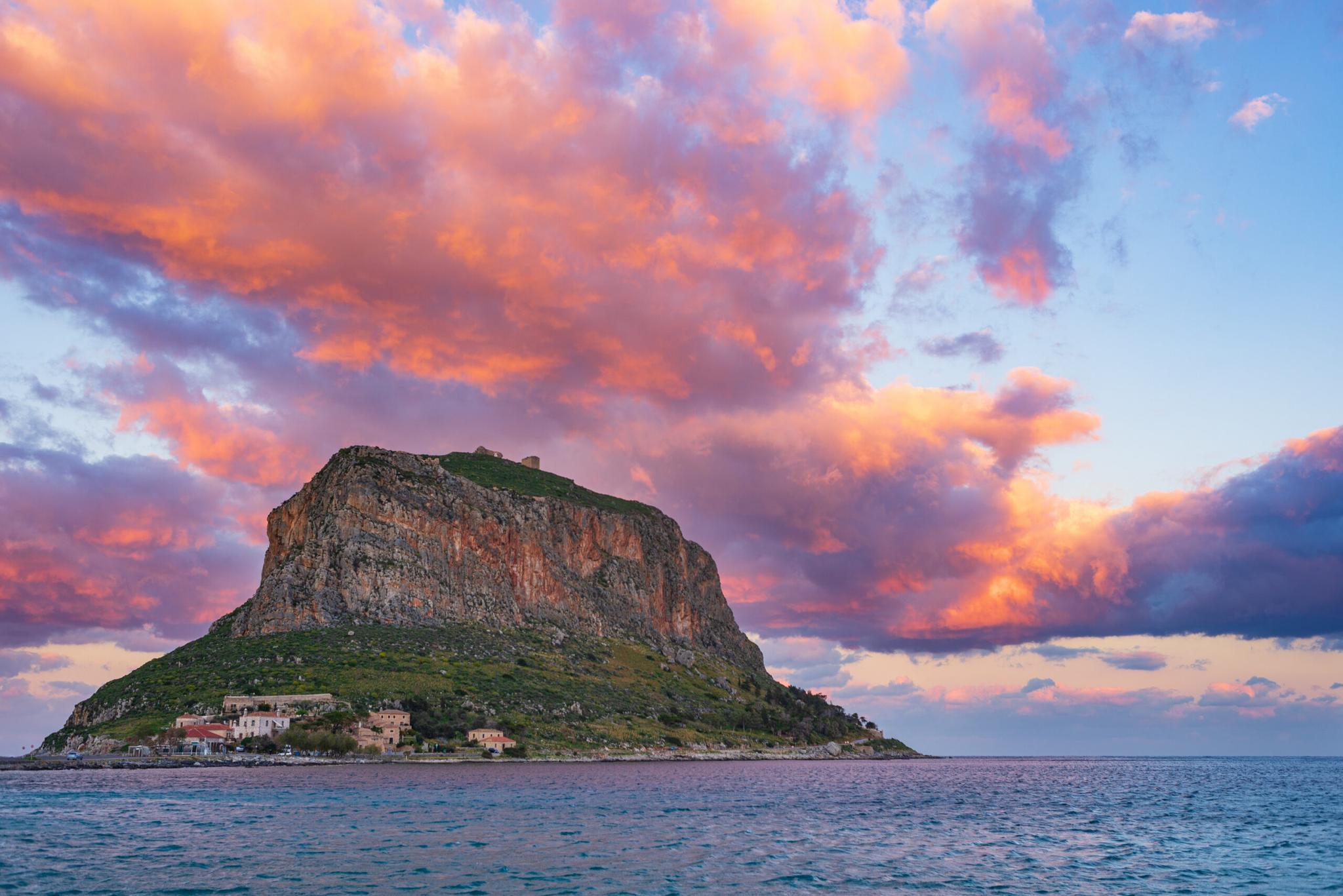
Laconia & Monemvasia
The eastern shadow of the Taygetos — Mystras, Sparta, the rock of Monemvasia. A long valley of orange groves, two seas, and three places heavy with history.
The valley between two ranges, and the rock at the end of it.
Laconia is the southeastern finger of the Peloponnese — Sparta’s old territory, the Eurotas valley running south between the Taygetos and Parnonas ranges, opening onto two seas at the bottom of the country.
The valley itself is citrus and olive country, with the modern town of Sparti at its centre and the ghost-city of Mystras on the hill above. To the east, the Parnonas drops to the Aegean; to the south, the long Malea peninsula runs past Monemvasia — a Byzantine town carved into a sea-rock — and down through Vatika to Cape Maleas, where the Laconian Gulf meets the Aegean. Off its western shore, in the Laconian Gulf, the small island of Elafonisos holds Simos, one of the best-known beaches in Greece.
From the Taygetos to Cape Maleas.
Hover the map or the list — they're linked. Numbered roughly the way you'd drive them.
- 01The mountain
Taygetos (E)
The eastern slope of the Taygetos rises straight from the Eurotas valley to 2,407 m — mountain villages, monasteries, the refuge hike to Profitis Ilias.
- 02Inland
Geraki
A medieval Frankish castle and a Byzantine ghost-village above the eastern Eurotas — like a smaller, quieter Mystras with no tour buses.
- 03East coast
Kyparissi
A village in a green amphitheatre on the Parnonas coast — limestone cliffs, climbing routes, deep-water swimming and a handful of tavernas. The Mediterranean before tourism.
- 04The end
Cape Maleas
The dramatic southeastern tip of the Peloponnese — a treeless headland where two seas meet. A monastery at the very tip, an 1883 lighthouse, and a long, shadeless path out to it.
- 05Island
Elafonisos
A small island ten minutes off the coast, holding Simos — a 1.5-kilometre double arc of white sand and turquoise water, and one of the best-known beaches in Greece.
- 06Old port
Gythio
The ancient port of Sparta — a horseshoe of red-tile fishermen’s houses, a tiny island reached by a causeway, and a long row of fish tavernas on the harbour.
- 07Eurotas city
Sparta
The modern town below ancient Sparta — a working agricultural centre, the acropolis of the ancient city, and the gateway to Mystras and the Taygetos.
- 08UNESCO
Mystras
The hill-city of the late Byzantines, abandoned after 1834 — ghost streets, frescoed chapels, the Despot’s Palace looking down over the Eurotas valley.
- 09The rock
Monemvasia
A medieval town carved into the side of a 200-metre sea-rock, reached by a single causeway. Two churches, a Venetian fortress at the summit, and one of the great walks in Greece.
Two ways to meet the place.
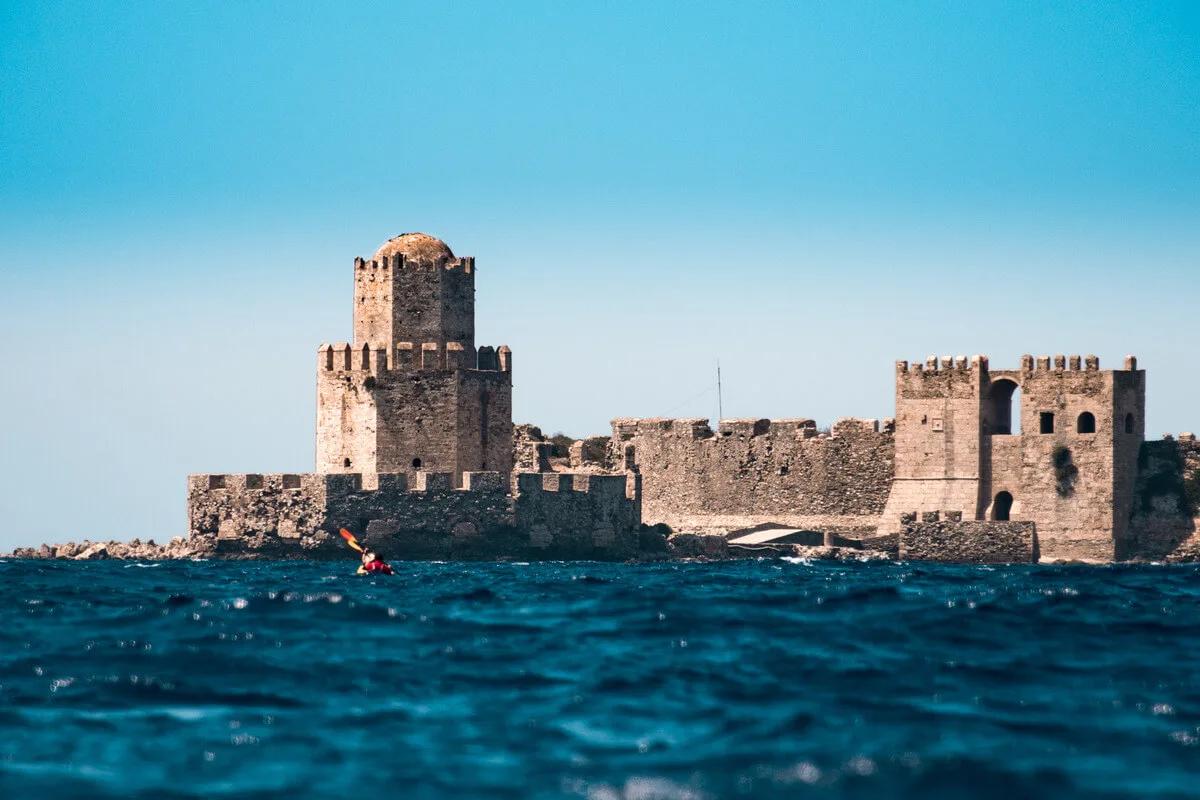
Sea kayaking around the rock of Monemvasia, or a summit hike up the Taygetos.
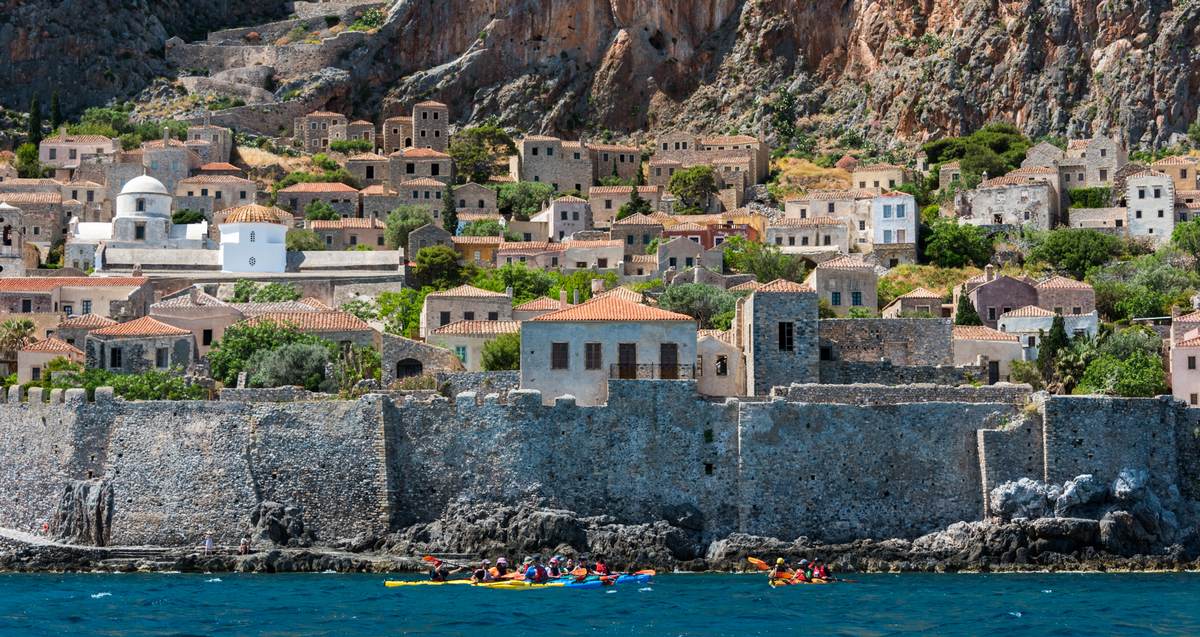
Sea kayaking around Monemvasia
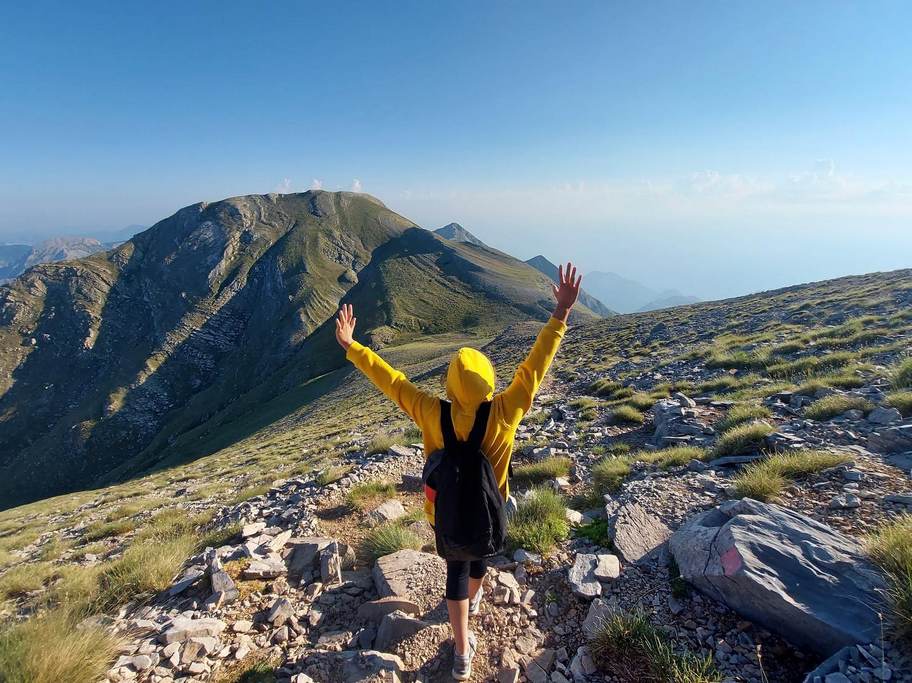
Summit hike up Mount Taygetos
Trips shaped by the rock.
Week-long trips built around the valley, the rock and the two seas at the bottom of the country.
The Peloponnese Larder
Agiorgitiko in Nemea, Malvasia at Monemvasia, syglino in Areopoli and Fileri from 1948 vines.
The Odyssey – Telemachus’ road
Linear B at Nestor's palace, Navarino Bay by kayak, Taygetos on foot, sunset at the Menelaion.
Classical Peloponnese
Epidaurus theatre, Mycenae's Lion Gate in the morning, Byzantine Mystras, Messene's walls and Olympia's 5th-century workshop of Pheidias.
Across the Peloponnese
Epidaurus on day one, Monemvasia's lanes at first light, a Mani sea kayak morning, Voidokilia at dusk.
Crossing Taygetos: Sparta to the sea
Byzantine Mystras, Profitis Ilias at 2,407 m, 17.2 km down the Viros Gorge, a swim in Kardamyli.
E-MTB across the Peloponnese
Fir forest from 1,700 m, the Lousios Gorge rim, 1,941 m down Taygetos, sunset at Voidokilia.
When to come.
Wildflowers
The Eurotas valley turns green; wild flowers on the Parnonas slopes. Mystras still quiet. Sea still cold.
Climbing
Best months for Kyparissi and the Taygetos. Sea reaches 22°C by mid-June. Long evenings on the Monemvasia walls.
Full summer
Hot inland; cooler on the southeastern coast. Elafonisos at its most crowded; the eastern coves stay quieter. Open-air summer festivals in Sparta and at Xirokambi.
Our favourite
Sea still around 25°C in September. October opens the olive harvest in the Eurotas; the citrus turns colour late in the month.
Citrus & oil
Citrus harvest in the valley; first snow on the Taygetos peaks. Monemvasia stays open through the winter; Kyparissi and Elafonisos largely close.
What makes Laconia, Laconia.
Mystras, and the last Byzantine renaissance
For two centuries (1262–1460) Mystras was the cultural and intellectual centre of a shrinking Byzantine empire. The philosopher Plethon taught here; some of the finest late-Byzantine frescoes in Greece line the churches of the Pantanassa, the Perivleptos and the Metropolis. Walking the abandoned upper city, with the Eurotas valley below, comes close to time-travel.
Monemvasia, the Gibraltar of the East
A 200-metre sea-rock connected to the mainland by a single causeway (the name means “single entrance”), Monemvasia was a Byzantine fortified town from the 6th century, then Venetian, then Ottoman, then Greek. The lower town — lanes of stone houses, Byzantine churches and a square — has been continuously inhabited for 1,400 years. Above it, the upper town is open ruin and wildflowers, with the 12th-century church of Agia Sofia still standing on the cliff edge.
Citrus, olives, and a particular silence
The Eurotas valley between the Taygetos and Parnonas is a working agricultural place — oranges, lemons, olives, the modern Sparta of football clubs and farm cooperatives. The villages of Sklavochori, Anavryti, Mystras village hold a particular Laconian quality: small squares with plane trees, kafeneia run by the same families for generations, an honest disinterest in being looked at.
What grows here, and how it’s eaten.
Laconian cooking is the cooking of a long valley: citrus, olive, mountain herbs. The food is unfussy and depends on what came in that morning from the gardens above Sparta or the boats at Gythio.
Honey pastry
Thin sheets of dough rolled, fried, dipped in hot honey and walnut. A Peloponnese wedding sweet; sold by weight at village bakeries.
Slow chicken stew
Rooster or chicken cooked slowly with onions, sfela cheese and kalamata olives; a dish from Bardounia, the hill country on the eastern side of the Taygetos.
PDO brined cheese
A semi-hard sheep’s and goat’s milk cheese matured in brine in long strips (“sfeles”), made only in Laconia and Messinia. Sharp, salty, perfect grilled.
Citrus
The Eurotas valley is the biggest orange-growing area of the Peloponnese — navels such as Navelina in winter, Valencia into summer. In the Sparta markets all winter; fresh juice at the cafés.
Malvasia revival
Monemvasia gave its name to Malvasia — the medieval sweet wine the Venetians shipped from here. Since 2010 the Monemvasia-Malvasia PDO has revived it as a sweet wine from sun-dried grapes, made around Monemvasia.
Mountain spirit
The Taygetos villages distil tsipouro from grape marc after the harvest. Drunk neat with mezedes; a small glass with coffee in the morning is not unusual.
Four kinds of room.
Inside the walls of Monemvasia, on a farm in the Eurotas valley, in the coastal villages, or up in the Taygetos and Parnonas.
Hotels inside Monemvasia
Small hotels and guesthouses built into the medieval houses of the lower town. Stone vaulted rooms, sea-facing terraces, no cars. Malvasia Traditional and Byzantino are two of them.
Working farms with rooms
Farm stays in the lower valley: Eumelia, an organic olive farm near Gouves, has five guest houses, olive picking in season and meals from its own produce.
Small hotels on two seas
Small hotels and studios in the coastal villages: Plytra and Archangelos on the Laconian Gulf, Kyparissi on the Aegean side. In Kyparissi, Paraliako sits fifty metres from the beach.
Taygetos & Parnonas guesthouses
Stone-built guesthouses in Anavryti on the Taygetos and in Polydroso and Kosmas on the Parnonas. A few rooms each — Archontiko in Anavryti has five — and walking from the door.
Before you go.
01Getting there
Most travellers fly into Athens (ATH) and drive via Tripoli — about 3 hours to Sparta, 4½ to Monemvasia. Kalamata (KLX) is closer for the southern coast (about 3 hours to Monemvasia, 2 to Gythio) and is the smarter choice for combining Laconia with the Mani.
02Getting around
A car is essential. The valley spine and the southern coast roads are fast; the eastern Parnonas coast (to Kyparissi) is slow and beautiful; the Taygetos villages are 30-minute hairpins. Allow 2 hours Mystras→Monemvasia.
03When to come
May–June and September–October. Mystras is hot in midsummer; the Monemvasia walls glow in October light. Kyparissi works April–October; Elafonisos June–September.
04What to pack
Walking shoes for Mystras and the upper Monemvasia. Swim shoes for the southern coves. Layers for the Taygetos in shoulder season. A torch for the Monemvasia lanes after the day-trippers leave.
05Book ahead
Hotels inside the rock fill early for May, September and October. Kyparissi has few beds — Paraliako, Kyfanta’s fifteen studios and a handful of rentals. Mystras has plenty of options in nearby Sparti or in Mystras village.
Let us shape your week here.
Tell us a little about the trip you want — pace, who's coming, how you'd like to spend your mornings. We'll build the days.